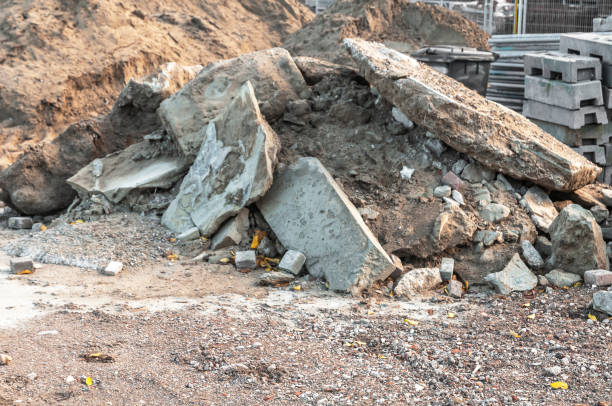
Recycled concrete aggregate has a long track record as a base material. It compacts well, it drains, it is produced close to where it is used, and it keeps a substantial volume of demolition material out of landfills. On a lot of Florida projects it is the sensible choice on both cost and sustainability grounds.
It is also a material where processing quality determines whether it performs. RCA that has been crushed and screened properly behaves predictably. RCA from a pile that was never controlled does not, and the problems show up during placement or, worse, after.
What the specification is actually asking
Base material is specified on gradation, on the properties of the aggregate itself, and on how it behaves once compacted. For recycled concrete, the practical requirements come down to a few things:
- Gradation within the specified band — a controlled distribution of particle sizes, not simply "crushed concrete"
- Limits on deleterious material — the wood, plastic, asphalt, soil, reinforcing steel and general debris that arrive with demolition material
- Consistency across the quantity being supplied, so that what is tested represents what is placed
- Compaction behaviour that meets the density requirement without excessive effort
None of these are unusual. What is different about RCA compared with virgin aggregate is that meeting them depends heavily on what went into the crusher.
Contamination is a source problem
The deleterious material limits are where most RCA falls down, and it is almost always traceable to the feedstock rather than the crushing.
Clean structural concrete from a controlled demolition produces excellent material. Mixed demolition debris — concrete with masonry, with wood framing, with roofing, with soil from the excavation — produces material that has to be worked much harder to reach the same standard, and sometimes cannot get there at all.
The reinforcing steel question is a processing one and is well handled by magnetic separation, but only if the process includes it. Steel that survives into the finished product is both a specification failure and a hazard for tyres on the site.
Fines, moisture and the Florida factor
Crushed concrete generates fines, and fines govern how the material handles. Too few and the base will not lock up under compaction. Too many, particularly combined with moisture, and the material becomes difficult to work and slow to reach density.
This matters more in Florida than in drier regions. A stockpile that sits through a wet season without drainage holds water in a way that changes its behaviour on delivery, and the moisture content that shows up in a test on Monday may not be what arrives on Thursday. Stockpile management — drainage, segregation, working the pile in a controlled sequence — is not housekeeping. It is quality control.
Where the hauling side comes in
RCA economics are dominated by transport, the same as reclaimed asphalt. It is a low-value, high-weight material, and every additional mile erodes the advantage over virgin aggregate. The sustainability argument survives long hauls; the cost argument frequently does not.
VLJ coordinates a network of tri-axle dump trucks operated by independent owner-operators through our dispatch team, which lets the truck count be matched to the placement rate rather than to a fixed number of vehicles. On base work, where the constraint is usually how fast material can be placed and compacted rather than how fast it can be delivered, that flexibility avoids paying for trucks queuing on site.
Questions to ask your supplier
Before committing RCA to a job, it is worth establishing:
- What is the feedstock? Structural concrete from known sources, or mixed demolition?
- Is the material segregated by source, or blended into a general pile?
- What testing exists, how recent is it, and does it represent the quantity you need?
- How is the stockpile managed for drainage and moisture?
- How far is it travelling, and does the cost advantage survive the haul?
A supplier who can answer those readily is running a controlled operation. One who cannot is selling crushed concrete and hoping it meets the band.
If you have base work coming up and want to talk through recycled aggregate on your project, get in touch.